Thanks! :)
Wednesday, July 14, 2010
0918 948 2520 <- My new number
I finally changed my mobile number. Please save it (+63 918 948 2520) and delete the old one.

Tuesday, May 4, 2010
Twitter and Opera Mini 5: The Future of Android Apps
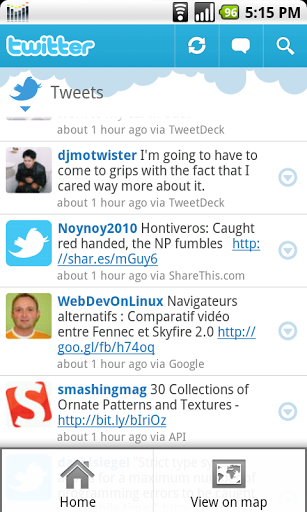 Android is great, but like any other platform, there's room for improvement. As I wrote before, Android has conventions that are bad for UX. I was actually afraid that these conventions could not be broken, because those hardware buttons are here to stay and forcing changes could bring injustice to Android hardware buttons.
Twitter and Opera Mini 5 are two new Android apps that stand out because of their great UX design. I don't know if I should consider this fortunate or otherwise, but they're good because of not following Android conventions.
Twitter's deviations from Android app conventions include the title bar (thicker and has clickable elements), putting buttons on the screen that are usually found in the menu, and having different look and feel of tabs.
Opera Mini 5's share of deviations include the lack of menu, using the menu button to show/hide the Address Field / Search, and the inclusion of a mouse pointer among many others.
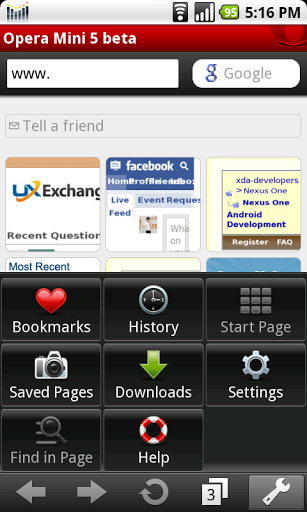
I consider all of the said deviations positive. Contrary to what I believed, the hardware buttons are still useful. They are also great especially because of showing more of the necessary GUI elements on the screen. It's time to graduate from hiding too many buttons in the menu. As I said, things that we see influence what we do. As long as clutter is avoided, it is good to show the user more of what's happening with an app and what he can do with it. After all, Google is open enough to allow deviations.
Twitter and Opera Mini 5 hold the key to the future of Android apps.
Friday, April 2, 2010
Is the iPad a Wasteful Innovation?

When the iPad was announced, people made fun of it. In a world full of laptops, netbooks, and smartphones; what unmet need would the iPad address? It runs a version of iPhone OS, which is not significantly superior to the smartphone. Is its hardware significant enough to justify the existence of iPod Touch Jumbo?
"Technology first, invention second, needs last"
Don Norman described in an essay that design or marketing research did not play significant roles in shaping powerful inventions. He said that it has always been "technology first, invention second, needs last." Inventions are not always needed, but when they succeed, they affect our lives greatly. If you think about it, life used to be fine without cellphones.
Great UX design over features
Tim Gideon from PC Mag said:
There may be things it doesn't do, but what it does do, it does remarkably well.This new type of mobile device isn't a smartphone or a laptop. Those two do things that the iPad doesn't. However, the iPad seems to do some things better than others. The tangible feel of the web on iPad is better than the browsing experience on laptop and desktop computers. The larger screen of the iPad doesn't require mobile versions of websites, unlike smartphones or other smaller devices.
How about tablet PCs that largely share the same form factor? Apparently, even if those computers do more than the iPad, the great unique experience that the big iPod Touch provides is more significant than its lack of features.
The slate is already influential
At this early stage, the iPad is already very important that the web and other things are being shaped to adapt to its existence. Many are moving to HTML5 and new mobile applications are being made just for the iPad. As Don Norman said; most inventions fail, but the ones that succeed change our lives.
Hiding features is better than removing features
When a person can carry an iPad, he can manage to bring a laptop or a netbook instead. iPad owners could end up carrying a laptop, an iPad, and a smartphone most of the time. This means many overlapping features. Now that it appears that Swiss knives aren't always better than specialists, humanity should find a way to conserve resources. Having to maintain many devices is very wasteful. A laptop replacement, which also has the great things about the iPad, would be best. There may be some people who can afford to purchase and bring many devices with them, but waste is not justified. Perhaps, avoiding this waste is a greater need than the small pretty things about the iPad. This piece of technology should get nothing more than the attention that it deserves.
Tuesday, March 30, 2010
Physical Ergonomics of GUIs on Touchscreen Devices
 Touchscreen devices are becoming more popular these days, especially mobile ones. The market is full of great touchscreen smartphones from different makers. The release of the iPad will probably contribute more to this.
My question on UXExchange regarding window control positioning and arrangement started a discussion on how physical ergonomics should be considered when designing those controls. Perhaps, this issue would be a lot more relevant for touchscreen devices. Furthermore, window controls aren't the only elements that should be considered when talking about the physical ergonomics of interacting with a GUI.
The form factor of devices, screen size of devices, handedness of people, and effort required to hold the device are some of the factors that could affect the interaction of fingers of people and touchscreen interfaces.
The world should prepare to face a finger-friendly internet. The spotlight starting to move away from the mouse.
Saturday, February 20, 2010
The Power of Prompts on GUIs
 I came across the idea of "prompts" on GUIs when I asked this question on UXExchange.com. Two people answered that "Share This" buttons prompt readers to share.
I have never used a "Share This" button or anything of that sort. Whenever I find something interesting online, because of the highly ergonomic setup of my computer, I always had the impression that sharing content on the web would always be more convenient if I do it manually than through an automated process, which could even compromise my social networking accounts. I haven't tested this so I don't have the numbers, but it's logical that "Share This" buttons can prompt people to share information, whether they are going to use the sharing service or not.
Recently, I have notable "prompting experiences" on mobile operating systems. On the iPhone, because of the limited hardware buttons, opening menus are done through the GUI. I appreciated this when I started being an Android user. On Android; going back to the previous screen, opening menus, and searching are all done with the use of hardware buttons. How are you going to know if and how those buttons are going to work on a certain screen? You have to test. There's nothing to prompt you.
Prompting and the lack of it largely influence the world. They're the advertisements of activities.
My Blog's Ironic Shortcoming
I intended this blog to be a source of reliable information on human experiences with technology. The quality of my entries had always been my primary concern. I wanted to write entries that aren't far from journal articles. With that mindset; I tended to postpone posting because of the lack of time to write something lengthy, desire to share only big ideas, and reserve sharing great thoughts in more profitable venues. As expected, I rarely post and my few entries aren't as presentable as I want them to be.
This blog is relatively new and it probably doesn't have an audience that is committed enough to read lengthy posts about highly technical things. I'll keep in mind that I'm not blogging about pop stars so I'll have to make my posts as usable as possible for varied personas.
This blog is relatively new and it probably doesn't have an audience that is committed enough to read lengthy posts about highly technical things. I'll keep in mind that I'm not blogging about pop stars so I'll have to make my posts as usable as possible for varied personas.
Subscribe to:
Posts (Atom)
